
- Intelligent Automation
- Written By Namita Bhagat
How to Select a Business Automation Partner (5-Point Checklist)
16-Dec-2025
Vendor selection is critical to achieving satisfactory results from process automation initiatives. If you’re wondering how to select a business automation partner that fits your needs, this guide will help you avoid common traps and choose wisely.
You can use this five-point evaluation checklist in the RFP process. It will help you compare automation solution providers objectively, reduce vendor risk, and increase the likelihood of real, sustained ROI.
In particular, the guide is useful for mid-to-large organisations and enterprises, which typically have more complex processes, greater integration challenges, and stricter governance and compliance requirements—well beyond one-off desktop automations!
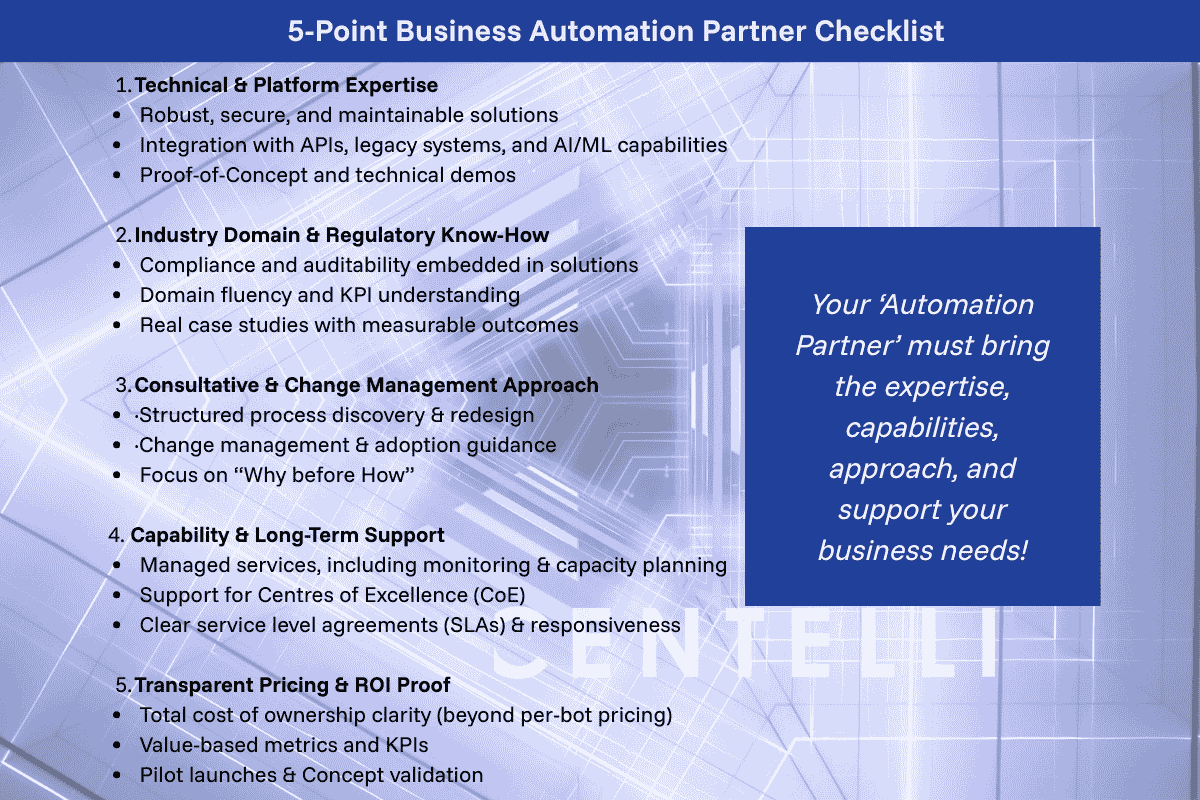
5 Pillars of Business Automation Partner Evaluation
No matter your organisation’s automation maturity, you must choose the right solution and select a business automation partner that suits your exact needs. And this requires deep diligence!
After all, this is not merely a procurement task, but a strategic decision. So, any potential automation solutions provider should be evaluated across the following core criteria:
- Technical and Platform Expertise
- Industry Experience and Regulatory Know-How
- Consultative and Change Management Approach
- Scalability and Long-Term Support Model
- Transparency in Pricing and Proving ROI
Let’s unpack these one by one.
1. Technical and Platform Expertise
At the outset, your automation partner’s technical capability determines whether a solution is robust, secure, and maintainable—or brittle, risky, and costly to support over time.
Key criteria for evaluation
a. Platform Depth and Architectural Judgement
A credible solutions partner demonstrates a strong expertise in the automation platform they recommend. More importantly, they can clearly justify why a platform is the right fit for your environment, scale, and automation goals.
Whether they specialise deeply in a single ecosystem or support multiple platforms, the focus should remain on fit-for-purpose design—not tool-led delivery.
Accordingly, look for evidence of depth rather than breadth alone. This includes complex, production-grade implementations, certified engineers, and clear solution architectures.
Equally important are examples of how they have customised automation solutions based on both technical and business constraints.
b. System Integration Prowess
Integration is where many an automation projects stall.
Therefore, select an automation partner who demonstrates clean approaches to APIs, middleware, and legacy screen-scraping fallbacks when APIs are unavailable.
To validate this, ask for a documented example of a legacy ERP integration. Specifically, understand the authentication method used, how errors were handled, and how success was measured. The outcomes could be reduced exception rates or lower manual reconciliation, for instance.
c. AI & ML Capabilities
Today, automation must handle both structured and unstructured data. As such, inquire whether the vendor can layer machine learning (ML) models and artificial intelligence, such as OCR or document understanding, and decisioning logic over RPA workflows.
Learn about our Intelligent Automation / Digital Worker Solutions ->
d. PoC and Technical Demos
This is where pre-hire evaluations become tangible. At this stage, a capable service partner should be able to demonstrate:
- End-to-end process flows, not just screen recordings
- Exception handling and retry or compensation logic
- Performance metrics from a live or comparable environment
2. Industry Experience and Regulatory Nuance
While generic automation expertise has value, domain knowledge significantly reduces risk. So, ask whether your prospective business automation partner has experience in your sector or adjacent industries.
If they do, they are better positioned to manage compliance requirements, data sensitivity, and operational constraints.
Key criteria for evaluation
a. Domain Expertise
The right partner should use your terminology and understand your KPIs from the very first conversation. At the same time, they should quickly identify relevant regulatory triggers and data sensitivities.
Pay attention to whether they:
- Reference common process bottlenecks in your industry
- Summarise key regulatory considerations relevant to your sector
b. Compliance and Governance
Effective automation must preserve auditability and control. This is typically achieved by embedding logging, role-based access, and immutable audit trails into solution designs. You can assess the service provider by reviewing how they approach governance during design discussions.
c. Relevant Case Studies
Request case studies aligned with your context—similar processes, comparable technology stacks, and measurable outcomes. Ideally, these should cover the problem statement, solution architecture, and quantified results.
Equally, credible partners will openly discuss challenges encountered and how they were resolved, not just the final success.
Check out some of our client case studies here-> Drop a line for more!
3. Consultative and Change Management Approach
For end-to-end / enterprise-scale implementations, automation is not simply a software installation. In practice, people, systems, and workflows are tightly interwoven. Therefore, automation often requires process redesign and cultural change, rather than a simple plug-and-play rollout.


Looking for a trusted partner to ease your business automation journey? At Centelli, we combine technical expertise, industry insight, and a consultative approach to deliver custom-built automations that scale, integrate seamlessly, and drive measurable ROI. Book a Free Call today.
Key criteria for evaluation
a. Process Discovery Path
A reliable automation partner goes beyond surface-level assessment. Specifically, they use structured As-Is mapping techniques such as process mining, workshops, and stakeholder interviews.
Through this lens, ask how they prioritise automation candidates. Strong partners score opportunities based on value, risk, complexity, and ROI—not just technical ease.
b. Answering “Why” Before “How”
Not every process should be automated as-is. Therefore, look for a partner who challenges assumptions and recommends simplification or elimination of unnecessary steps before automation.
c. Change Management and Adoption
The automation provider should clearly explain how they will train, guide, and support your internal teams. In addition, they should help measure adoption through usage metrics, exception rates, and operational feedback.
They may also share sample training plans or adoption frameworks from previous engagements.
4. Scalability and Support Capability
Why does this matter? Because if you expect active automation to grow with your business, post-go-live support becomes critical. So, select your business automation partner keeping this in mind.
Key criteria for evaluation
a. Managed Services
Clarify whether the partner offers monitoring, break-fix support, performance tuning, and capacity planning. Importantly, confirm whether these services are included or charged separately to avoid surprises later.
b. Centre of Excellence (CoE)
You may prefer a partner who can help establish an Automation Centre of Excellence. This enables access to reusable components, documentation, governance models, and training.
For large enterprises especially, a CoE supports scaled automation adoption, continuous improvement, and long-term innovation.
Explore our Automation CoE Enablement Services ->
c. SLAs and Responsiveness
A successful partnership depends on clear and mutually understood SLAs. Hence, set clear expectations around response times, resolution windows, escalation paths, maintenance schedules, and post-incident reporting.
5. Transparent Pricing and Proving ROI
Clear pricing aligns incentives and prevents hidden costs. That said, it’s equally important to recognise that guaranteed ROI cannot be promised upfront. Instead, ROI is maximised through strategic planning and disciplined execution on both sides.
Key criteria for evaluation
a. Beyond “Per Bot” Pricing
Ask for a total cost of ownership (TCO) view, including licences, infrastructure, integration effort, testing, training, and ongoing support. A reputable provider should be comfortable sharing a realistic estimate.
b. Value-Based Metrics
You should also clarify how success will be measured. Typically, this includes KPIs such as hours saved, error reduction, throughput improvements, FTE savings, or cost reductions.
c. Pilot Launch Option
Pilot automations are especially valuable for first-time initiatives or high-risk, high-investment programmes. In practice, a low-risk PoC with clear success criteria and acceptance tests helps validate capability before full-scale rollout.
In nutshell, a pilot allows you to test, refine, and understand how the vendor tracks and reports post-implementation ROI.
You May Also Like: Five ways to measure ROI in Intelligent Automation: A Guide
Conclusion
AI and Automation technology (service / platform /tool) are not tactical purchasing decisions. Instead, they directly influence how effectively your organisation drives value, manages risk, and scales automation over time.
Here, our five-point checklist provides you with a structured lens to help you evaluate and select a business automation partner. So, rather than relying on surface-level comparisons, go deeper before signing up for a solutions provider to drive your business transformation.