
- Digital Workers
- Written By Namita Bhagat
Enterprise Applications vs Digital Worker Automation: Why You Need Both
26-Feb-2026
Why use Digital Workers when automation is already built into our enterprise applications? Aren’t they just another automation tool? Value? Should we even consider ‘Enterprise Applications vs. Digital Worker Automation?
Yes, absolutely!
Because you must also ask: does your out-of-the-box (OOTB) ERP or CRM application automate enough? Does it require significant manual intervention, keeping teams tied up? And is it truly agile and resilient enough to handle growing operational complexity and challenges?
This blog addresses the most pivotal questions you may have:
- Where does app-native automation work well, and where does it hit the wall?
- What automation gaps do Digital Workers close once systems and workflows are already in place?
- How do Digital Workers extend existing applications, cut manual work, break silos within and beyond the application ecosystem?
- How do Digital Workers safeguard current system investments while enabling agility and scalability?
- How can Digital Workers help avoid costly application customisations, system replacements, or workflow redesigns?
You will also see, via examples, how Digital Workers and enterprise (or apps) deliver greater impact together.
Enterprise Applications and their Embedded Automation
Most businesses use multiple enterprise applications, each fulfilling a specific departmental requirement.
Some core applications include:
- Finance & Accounting (F&A) systems
(e.g., NetSuite, Sage Intacct, Oracle Fusion Cloud)
- Enterprise Resource Planning (ERP)
(e.g., SAP S/4HANA, Microsoft Dynamics 365, Infor)
- Human Resource Management Systems (HRMS)
(e.g. Workday, SAP SuccessFactors, Oracle HCM Cloud)
- Customer Relationship Management (CRM)
(e.g., Salesforce, HubSpot, Zoho)
- Supply Chain Management (SCM)
(e.g., Blue Yonder, Kinaxis, Manhattan Associates)
- Business Intelligence (BI) and Analytics
(e.g., Microsoft Power BI, Tableau, Qlik)
Moreover, a business may also use tools or applications for procurement, project management, regulatory compliance, or industry-specific purposes. The choice depends on the need. The automation scope varies from app to app, however. You may be using legacy on-premises systems or modern cloud platforms. Each offers some automation capability, but essentially within its own ecosystem.
Let’s take a closer look:
How Modern Enterprise Apps Automate
Modern applications embed structured automation in several forms:
- Batch processing of large volumes of data but not in real time.
- Electronic data interchange enables standardised document exchange between servers
- Scheduled job sequences execute pre-programmed chains of events.
- Stored procedures/triggers enable environment-locked database actions.
However, automation works only within defined parameters. It is most effective when processes stay within a single system and follow predictable logic.
How Much Legacy Systems Automate
Legacy applications typically provide more rigid automation: rule-driven, batch-oriented, and poor exception handling. For example:
- Batch processing of large volumes of data but not in real time.
- Electronic data interchange enables standardised document exchange between servers
- Scheduled job sequences execute pre-programmed chains of events.
- Stored procedures/triggers enable environment-locked database actions.
So, although modern on-premises and SaaS applications provide flexibility, even advanced systems typically automate individual tasks. By design, they do not support end-to-end workflows. As a result, processes spanning multiple systems often create bottlenecks. And teams must step in to close the gap!
Common Response to App-Native Automation Limitation
A point comes when app-native automation threshold turns into an unsustainable, undeniable operational drag. Organisations typically resort to:
- Customising the core application
- Upgrading to additional modules
- Adding point solutions or products
- Introducing new SaaS platforms


However, customising a vendor-defined application or pursuing a major upgrade has own trade-offs. The same goes for adding another SaaS tool. These can be:
- Increased architectural complexity
- Integration debt or operational disruption
- Tool or application bloat
- Higher maintenance overhead
- Fragmented, not end-to-end automation
Even then, significant manual work often remains, particularly across systems. Vendors build enterprise applications to standardise operations at scale. They are not designed to anticipate every organisation’s unique process nuances, complex exception patterns, or cross-system integration needs.
Sometimes, these limitations may also create shadow IT risk when departments or individuals turn to compensate for automation gaps.
Automation in Enterprise Applications vs Digital Workers
Both are software, but they serve distinct purposes in the digital environment of an organisation. Both bring automation capability, but in different ways and to different extents.
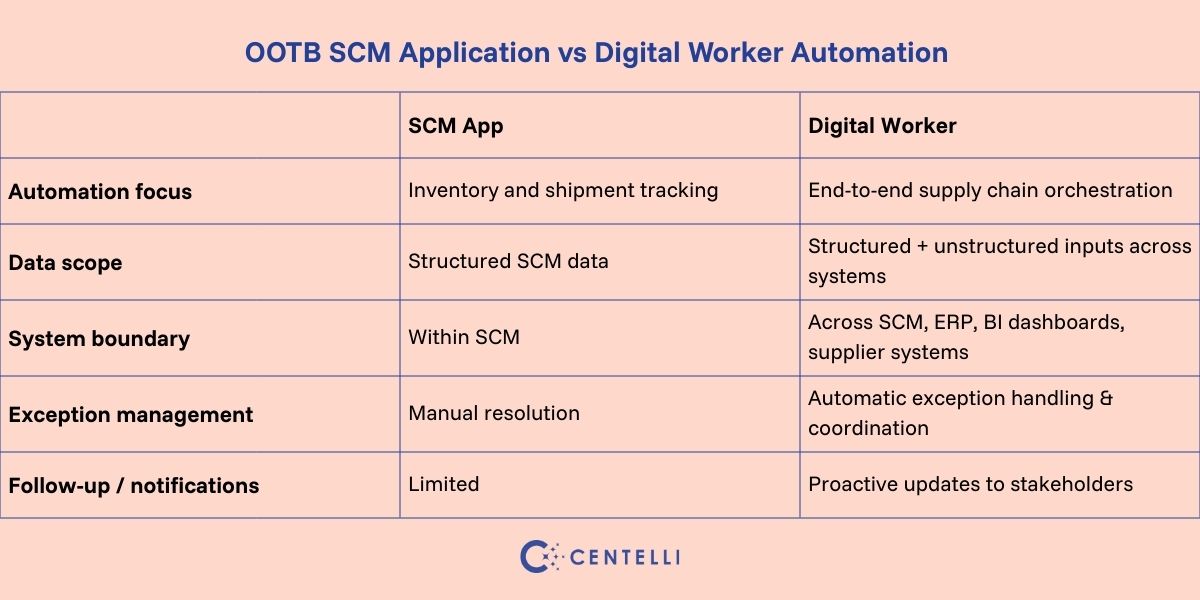
So, this is how enterprise applications vs digital worker automation looks like:
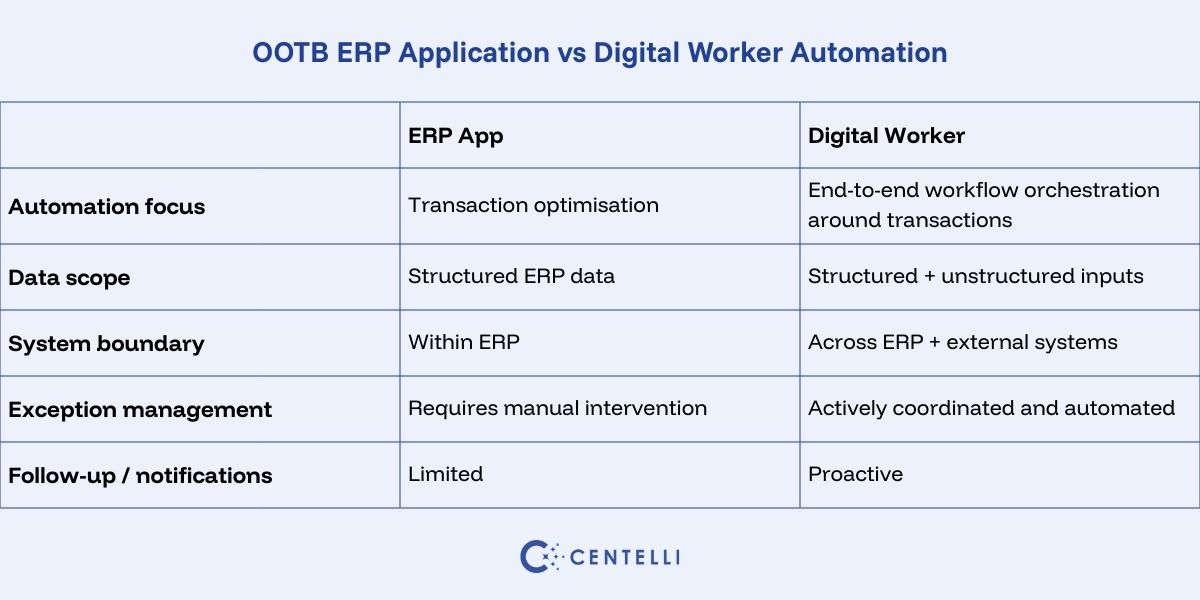
OOTB enterprise applications are primarily systems of record. A CRM stores customer data. An HRMS manages employee records. Their embedded automation operates within vendor-defined configurations and predefined workflows.
In contrast, Digital Workers are custom-built automation solutions designed around specific business processes. They mimic human interactions with systems and tools, following defined decision paths. They not only can handle isolated tasks but manage entire workflows with minimal supervision.
Here are some more distinctive attributes:
- App-native automation delivers task efficiency within an application’s boundaries. Digital Workers extend automation beyond those boundaries.
- Pre-built application configurations limit the scope of embedded automation. But Digital Workers are custom-built to a business’s exact processes and unique needs.
Despite their fundamental and purpose-driven differences, enterprise applications and Digital Workers can be complementary and synergistic.
How?
- Digital Workers use app data (the system of record) to execute actions.
- Applications benefit from Digital Workers automating additional steps and connecting what needs to connect. Less friction and better synchronization across platforms / systems enhances overall performance.
Notably, AI-driven Digital Workers can manage far more complex and dynamic workflows with a high degree of autonomy.
How Digital Workers Automate In and Beyond Applications
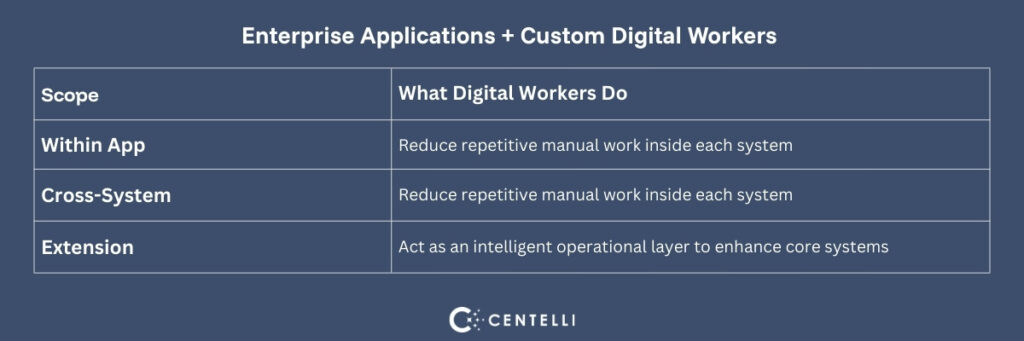
Digital Workers augment enterprise applications in two ways: within system boundaries and across system boundaries.
1. Tasks in Application’s Ecosystem
Legacy systems, obviously! But significant manual work persists even with modern ERP, CRM, HRM, and others. For instance:
- Reconciling entries in accounting systems
- Updating employee records across HR modules
- Extracting marketing campaign data for reporting
- Processing emails and PDFs in a helpdesk system
Assign Digital Workers to execute these tasks. No more endless hours on manual data entry, copying and pasting, or data extraction. They validate every input against pre-defined rules, ensuring accuracy and speed. AI-powered bots bring document understanding and unstructured data handling capabilities.
2. Cross-System Handshakes Outside App Boundaries
In a multi-application environment, seamless process flow depends on systems interacting effectively. For example:
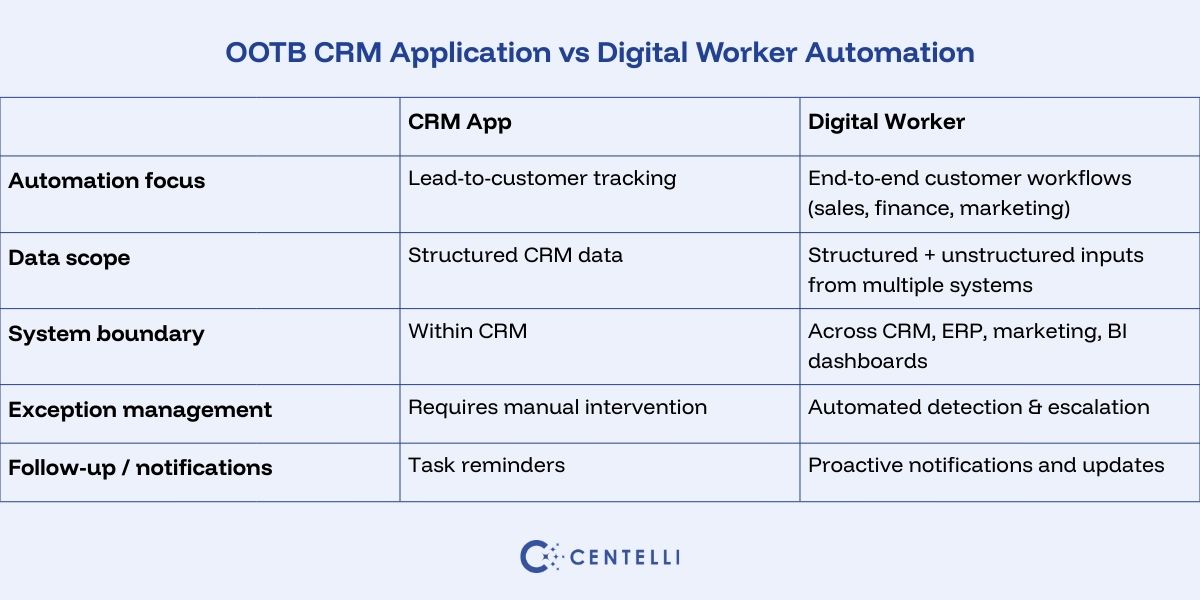
- A sales update in CRM triggering finance validation in ERP
- Supply chain exceptions requiring reconciliation across SCM and BI dashboards
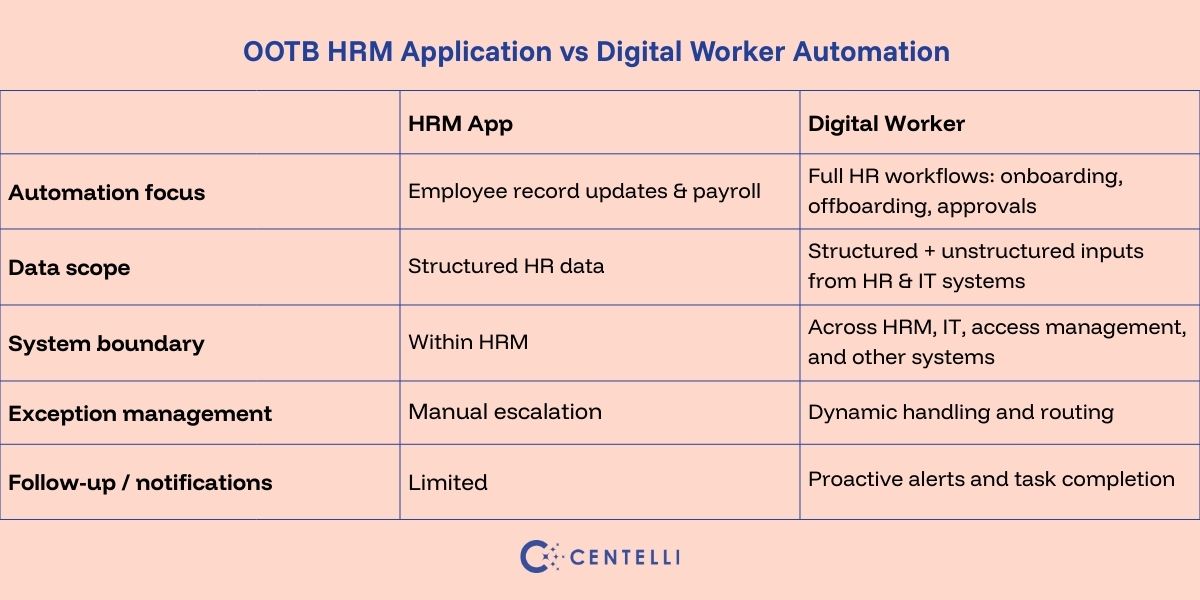
- HR onboarding coordinating HRMS, IT systems, and access management tools
- Hotel booking platforms synchronising with property management systems (PMS)
Usually, these handshakes rely on manual intervention or system integration platforms. Here, Digital Workers can replace manual coordination. They can also reduce dependency on custom integrations in certain use cases.
Digital Workers Augment Both Applications and Systems
Digital Workers automate complex, multi-step, or cross-app tasks that the embedded automation features can’t. They strengthen enterprise systems and applications by:
- Executing end-to-end workflows across multiple applications
- Handling exceptions dynamically instead of routing them back to users
- Bridging legacy systems that lack modern APIs
- Operating 24/7, independent of business hours
- Enabling process changes without requiring core system redesign
Digital Worker deployments orchestrate and optimise processes across the existing landscape. This helps avoid application customisation or adding extra tools. The system of record remains intact, while the automation layer becomes more intelligent and cohesive. This also preserves existing application investments while enabling scalability.
In essence, enterprise applications provide structure and data integrity. Digital Workers provide process continuity and operational intelligence. This saves employees from unnecessary workload and cognitive fatigue impacting their performance.
Also Read: How Digital Workers Deliver Smarter, Scalable Data Management Automation
The core idea is not fewer systems, but better orchestration. Not fewer people, but better utilisation of human capability. The synergy creates a seamless, round-the-clock operational ecosystem, maximising the value of every resource.
Explore how our custom Digital Workers reduce manual work and augment your active enterprise applications and systems. Book your free, no-strings-attached scoping session with Centelli to see what’s possible.
Go Beyond Enterprise Applications vs Digital Worker Automation; Leverage Both
While applications can automate standardised and predictable tasks, unnecessary manual work and fragmented workflows (still) remain. Digital Workers add not just tactical but also strategic value here.
Key Takeaways:
- Enterprise applications are primarily systems of record with embedded automation.
- Digital Workers extend this foundation, orchestrating end-to-end workflows and bridging systems. Additionally, they automate tasks and processes beyond an application’s boundaries.
- Together, they create a hybrid automation environment that reduces manual, error-prone work and enables faster, scalable operations.
- Their combined capabilities elevate organisation-wide efficiency, connectivity, and automation ROI. This reduces the need for frequent system upgrades or more point solutions for operational gaps.
You May Also Like: How the Enterprise Automation Ecosystem Looks in 2026