
A Digital Worker is not a standardised term or product. While traditional, rule-based frameworks are still very much in use, intelligent and more autonomous models are opening new frontiers. One idea, different forms, and many interpretations. So, what is a Digital Worker in 2026?
Task automation is only the first step. However, complex operations and growing scale require solutions that automate reliably across systems and workflows. This distinction becomes especially critical when organisations go past the early stages of automation. Notably, custom Digital Workers are designed for specific use cases, unique processes, or sector-focussed demands. They enable this transition by delivering seamless, scalable, tailored automation capability.
What is a Digital Worker? (Anatomy & Playbook)
A Digital Worker is not a single tool or a standalone technology. It is a structured way of executing work using a combination of automation capabilities working together. The objective is reliable, consistent process execution from end-to-end.
In real-world terms, a Digital Worker application:
- Automates complete, end-to-end processes rather than isolated tasks
- Combines execution, understanding, and decision-making in one workflow
- Reduces manual handling in repetitive, high-volume processes
Now, let’s break down what makes a Digital Worker!
Key Capability Layers
Digital Worker capabilities depend on the nature of the work that needs to be automated. Some processes only require execution. Others warrant understanding and decision-making as well. The construct rests on how predictable the process is and how much interpretation it needs.
Execution Layer
This is the foundation where the Digital Worker interacts with the UI or API. This involves clicking buttons, scrolling through digital records, and entering data into relevant fields. It may also require navigating between legacy systems, cloud platforms, and modern applications. So, the assigned task execution happens in this layer.
Understanding Layer
Most business work does not arrive in a structured format. This layer allows the Digital Worker to interpret text, classify documents, and extract specific data from unstructured inputs such as emails, attachments, or scanned files. Without this capability, classic automation usually stops at the point where human interpretation is required.
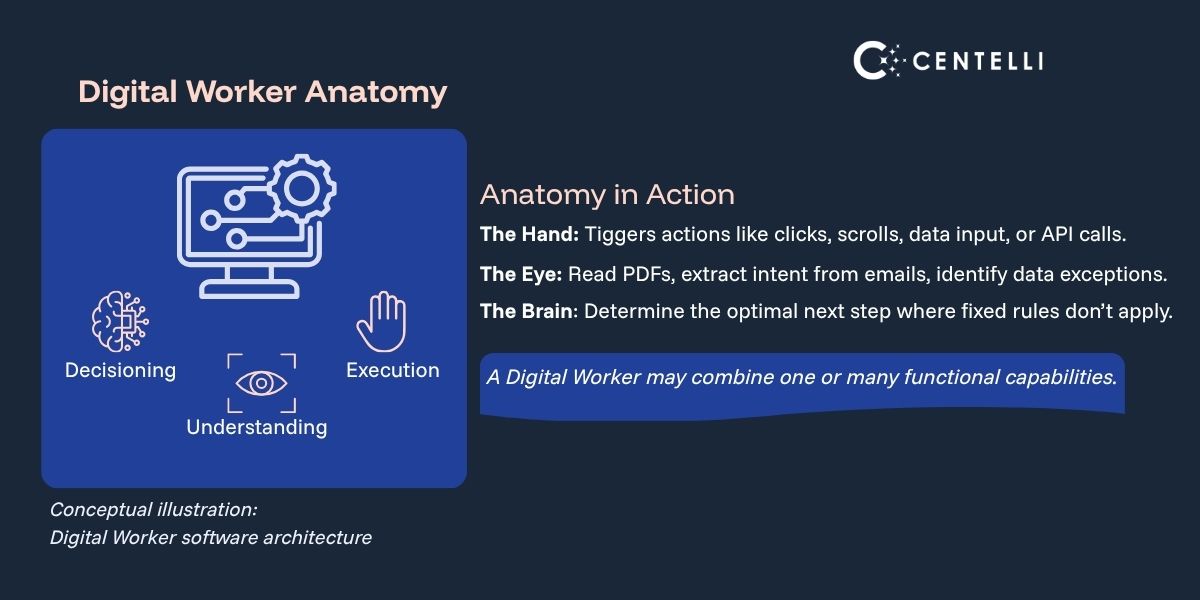


Decisioning Layer
Processes rarely stay perfectly predictable. This layer uses business logic, validation checks, and if/then rules to evaluate context, handle exceptions, or decide what needs to happen next. It allows automation to continue even when the process does not follow a perfectly linear path.
Digital Worker Capability in Action
A Digital Worker needs the ability to act, understand what it is working with, and decide what to do next. In essence, it’s a structured combination of capabilities working together. It’s easier to understand when we visualise how a human acts. Here’s the metaphorical description of Digital Worker anatomy in action:
The Hands: Performing the task
This is how a Digital Worker performs tasks. It logs into applications, moves data between systems, updates records, and completes transactions. In enterprise environments, this is what enables automation to work across multiple systems rather than inside a single application. (Process bots and API automation become the hands.)
The Eyes: Understanding real-world inputs
Most processes rely on documents, emails, and attachments. They might include unstructured information, such as text, images, or audio/visual media. This capability allows the Digital Worker to read, extract, classify, and organise data as needed. This is what moves automation beyond simple data entry and support real operational workflows. (OCR, document understanding, and computer vision are the eyes.)
The Brain: Decision-making during the process
Real business processes involve variations. These could be missing data, unexpected inputs, and changing interfaces. This capability allows the Digital Worker to evaluate the situation and determine the next step. The ‘brain’ can be designed to follow strictly pre-defined business rules. Or it can be more advanced using adaptive reasoning. This may not replace human judgement fully but removes a large part of time-intensive manual routines. (Business rules, decision logic, NLP, and machine learning serve as the brain.)
What a Digital Worker Is Not
Awareness and adoption are increasing, but understanding ‘what a Digital Worker is not’ is as important as appreciating what it is. The concept is distinct from out-of-the-box automation solutions and applications with embedded automation features. And you shouldn’t also confuse them with RPA and AI.
Digital Worker vs RPA: An RPA bot executes tasks with accuracy and repeatability but struggles with processes requiring contextual reasoning or unstructured data. A Digital Worker is a persona-based entity designed to own a specific role, such as a Digital Data Entry Clerk. It executes assigned workflows, moving between systems and managing both structured and unstructured data just like a team member.
Digital Worker vs AI: AI can analyse information and generate insights. However, it requires integration and execution layers (e.g., bots) to perform physical “clicks.” A Digital Worker may use heuristic (rule-based) or probabilistic intelligence combined with execution to complete work independently. As such, it is different from a standalone AI tool or copilot.
Furthermore, a Digital Worker is also NOT:
A one-size-fits-all product: While some standard automation exists, an enterprise-grade Digital Worker is predominantly bespoke. It must be configured around your specific processes, legacy systems, and internal rules.
OR
A replacement for process design: Automation works best when the process is clearly defined and stable. A Digital Worker improves efficiency, but it cannot fix a poorly designed workflow on its own.
Do All Digital Workers Use AI?
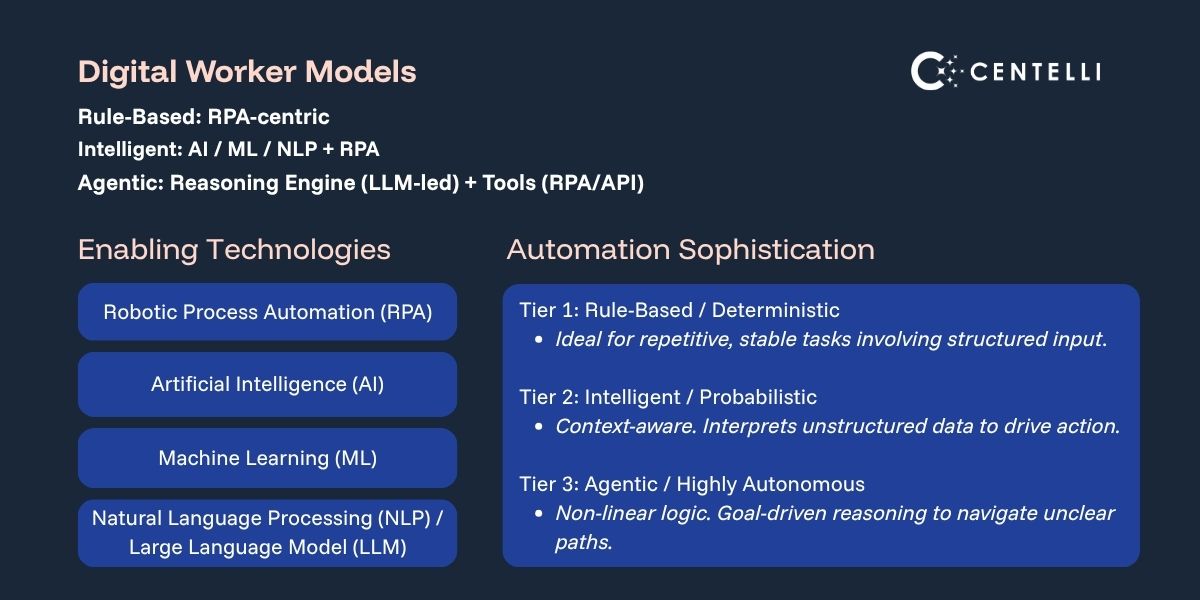
No, not all Digital Workers are AI-driven. Practically, it is defined by the work it executes, not by the tools it uses. So, the solutions exist across a spectrum:
- Deterministic Digital Workers: Handle structured, rule-driven work where the steps do not change frequently. AI is not required here. Many high-volume processes such as data entry or reconciliation fall into this category.
- AI-Powered Digital Workers: Combine execution with technologies such as machine learning or document understanding. This becomes necessary when the process involves unstructured inputs like scanned forms.
- Highly Autonomous/Agentic Digital Workers: Combine execution, understanding, and adaptive decision-making to operate with minimal human intervention. They are ideal for processes with high variability and require applying logic continuously.
Capability Designed Around Purpose
Effective automation is built around the “why,” not the “how.” In a mature strategy, the choice of Digital Worker model is dictated by the process need. Therefore:
- Execution capability is sufficient when a process is stable and strictly rule-based.
- Understanding capability is desirable when a process involves unstructured information like documents and emails.
- Contextual / decisioning capability is required for processes with high variability and non-linear logic.
Some examples of purpose-driven capability:
An accounting Digital Worker for invoice management: A non-AI Digital Worker can execute high-volume journal entries from structured ERP data. But you need an AI-enabled model when invoices arrive in multiple formats; it then needs “Eyes” (Understanding) to extract data and a “Brain” (Decision-Making) to handle mismatched amounts.
An HR Digital Worker handling onboarding process: A simple Digital Worker executes account creation for new hires based on structured HRIS data. You need an intelligent version when it must use “Eyes” to read scanned ID documents and a “Brain” to determine specific software permissions based on the hire’s role.
An intelligent Digital Worker doing a procurement task: A deterministic model automatically creates purchase orders (PO) when requisitions are structured. You need an adaptive version when supplier invoices arrive with inconsistent line items, requiring “Eyes” to extract the data and a “Brain” to verify the variance against the original PO.
Mapping Digital Worker Capability to Process
One should define a Digital Worker by the scope of work it handles. A modern enterprise environment leverages RPA, ML, AI, and system orchestration into a unified framework. This approach allows disparate systems and teams to work in unison, transforming fragmented tasks into seamless operations.
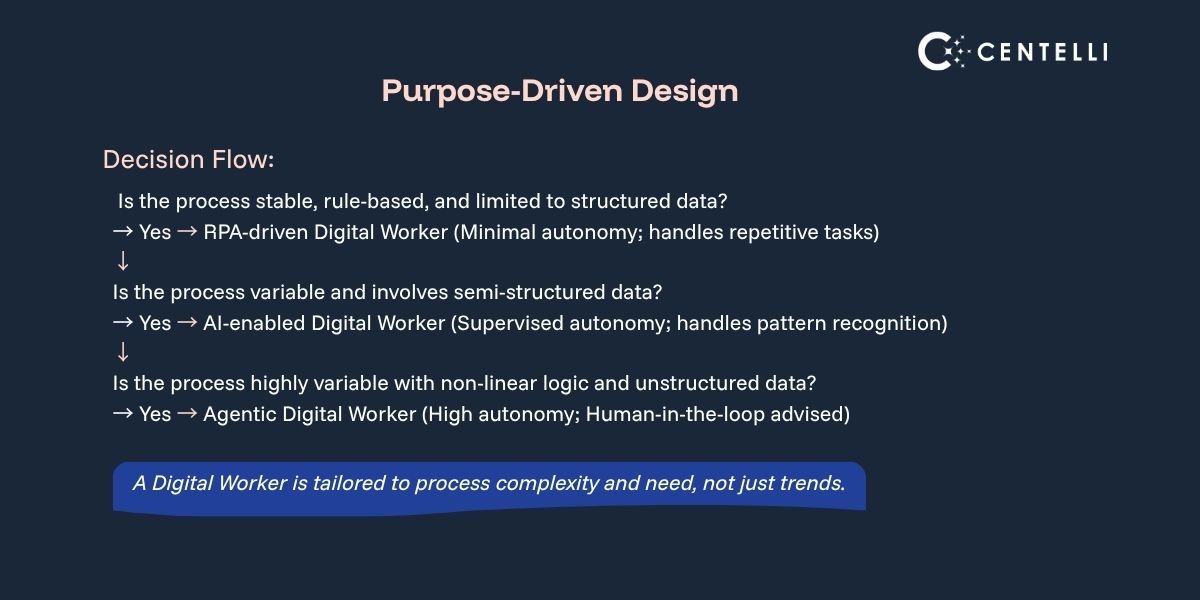
Consider these questions to understand what type of model your business needs:
- Is your process / workflow stable and clearly defined?
- Does the process involve unstructured information?
- Will the process need context-based exception handling?
- What is the level of autonomy the automation should have?
- At what points should a human step in for need or control?
Also, Digital Workers are not meant to replace teams; they liberate human talent for more strategic and creative work. Most businesses prioritise human-in-the-loop automation and AI frameworks to ensure governance and better control.
Ready to Move Beyond Fragmented Automation?
Organisations unlock greater potential when digital operations are connected, agile, and efficient. Automating end-to-end processes and workflows is a practical pathway to achieving that. However, the solutions you deploy must deliver real value and not just a ‘nice to have.’
At Centelli, we help businesses automate through Digital Workers and agentic automation, from strategy to deployment. We provide scalable, minimally invasive solutions that deliver rapid ROI and measurable impact. Book your free scoping call with us to discover how we can help you automate more effectively.