- Intelligent Automation
- Written By Namita Bhagat
Modernising Legacy Systems? This is How Digital Workers Ease Your Transition
29-Apr-2026 . 6 min read
This article explores how Intelligent Automation Digital Workers mitigate risks when modernising legacy systems. It shows how they navigate frictions to deliver value, whether you choose to retain, upgrade, or replace your existing systems.
Digital Workers can ease your legacy system modernisation journey. These specialised software agents add an ‘intelligent automation layer’ to the legacy tech stack that it lacks. While organisations know modernising legacy systems is inevitable, they continue to spend millions maintaining ageing systems.
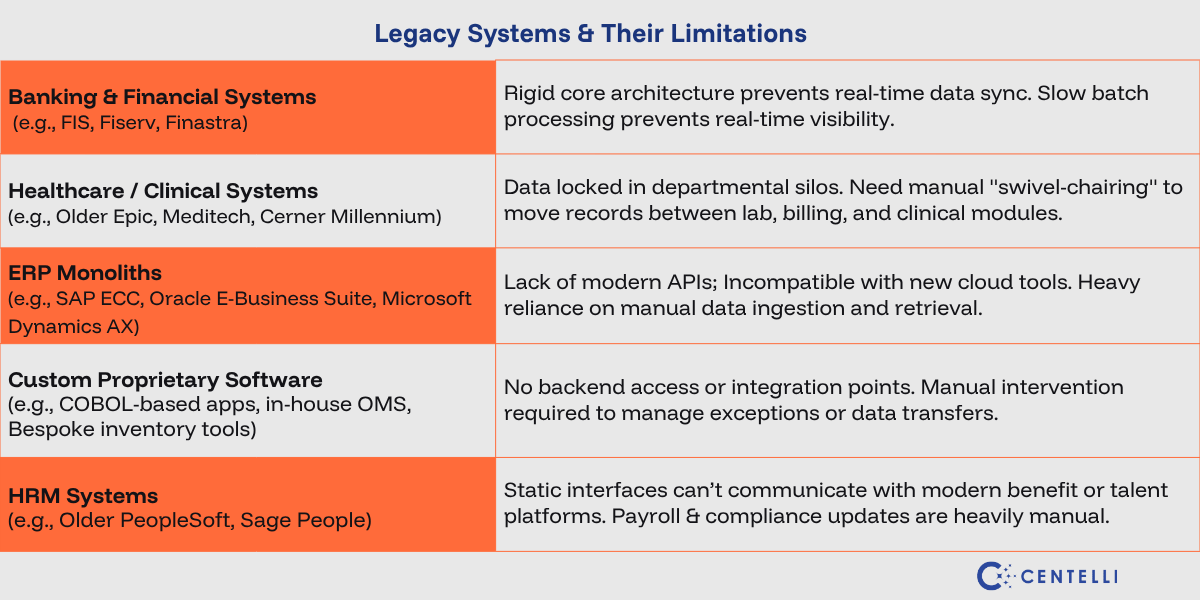
Hesitation to act is often rooted in the challenges associated with system modifications, upgrades, and replacements. Mainframes, custom proprietary software, and ERP monoliths house decades of data, processes, and business logic. Deeply embedded in the operational setup, these old guards underpin core operations. So, you cannot retire them overnight. Plus, you must also weigh technical complexity, downtime risks, and costs when making any changes.
Modernising core infrastructure is always challenging, but there are smarter ways to navigate.
Traditional Legacy Modernisation and Its Struggles
The standard legacy system modernisation playbook offers varied paths: Refactoring, Replatforming, Rearchitecting, and ‘Greenfield’ replacement. While each approach has its struggles and risks, they are also highly disruptive and time intensive. Let’s see how they play out:
a. Refactoring or modifying internal code: Restructuring system code improves performance and reduces technical debt. But it is a ‘black box’ project where internal workings are opaque. Documentation gaps and hidden dependencies may lead to budget spirals and project delays.
b. Replatforming or environment upgrade: When a legacy system moves from ‘on premises’ to cloud, for instance, the code stays largely intact. But this ‘lift and shift’ often leaves broken, manual workflows exactly as they were. Also, the system still lacks modern APIs.
c. Rearchitecting & Greenfield Replacement: You may rebuild the architectural foundation of an existing system. Alternatively, you can develop or buy a completely new system. However, even when you buy a brand-new S/4HANA or Oracle Cloud to replace a 20-year-old ERP, it can be a multi-year effort.
However, your business cannot afford to wait 12–36 months for a performance lift and miss growth opportunities or lose market standing. So, you need ‘something’ reliable to support active systems until the restructuring, upgrade, or replacement stabilises. Intelligent Automation-powered Digital Workers can be that reliable solution.
Modernising Legacy Systems with Digital Workers
Before we dive into how Digital Workers support legacy modernisation, here’s a snapshot of what they are:
- Digital Workers are low-friction, non-invasive software agents tailor-built for unique business needs.
- These intelligent automations can understand unstructured data, execute high-velocity data throughput with great accuracy, and connect systems by acting as a virtual API.
- These attributes are useful in legacy modernisation initiatives, too.
With Digital Workers taking over time-consuming, repetitive, error-prone tasks and swivel-chairing, you can overcome many potential hurdles regardless of the path taken. Let’s break it down:
Extend Legacy Systems with an Added Capability Layer
Legacy interface means endless typing, clicks, and scrolls. Hard-coded workflows and modern tool incompatibility mean exceptions and moving data between applications must be handled manually. Digital Workers are integrated as a buffer layer that does the ‘grunt work’ and connects digital silos. Wrapped in this layer, a legacy system can deliver a modern experience. This gives it a new lease of life and usability in modern digital operations.
Tame Disruption During System Modification or Upgrade
Legacy system modifications and upgrades typically involve refactoring modules, updating databases, and relocating to a cloud environment. These changes are less drastic than ‘replacement’ but still carry risk. Digital Workers add value here by automating testing, handling data migration, and maintaining process continuity while upgrades are phased in.
Orchestrate Between Old and New in System Replacement
Digital Workers ease the transition when a legacy system is replaced partially or fully. They orchestrate parallel processes during cutover and bridge old and new environments. This reduces operational disturbances and downtime. They make system modernisation initiatives less daunting and more manageable. By automating manual migration tasks and data portability, these intelligent agents make system modernisation initiatives less daunting and more manageable.
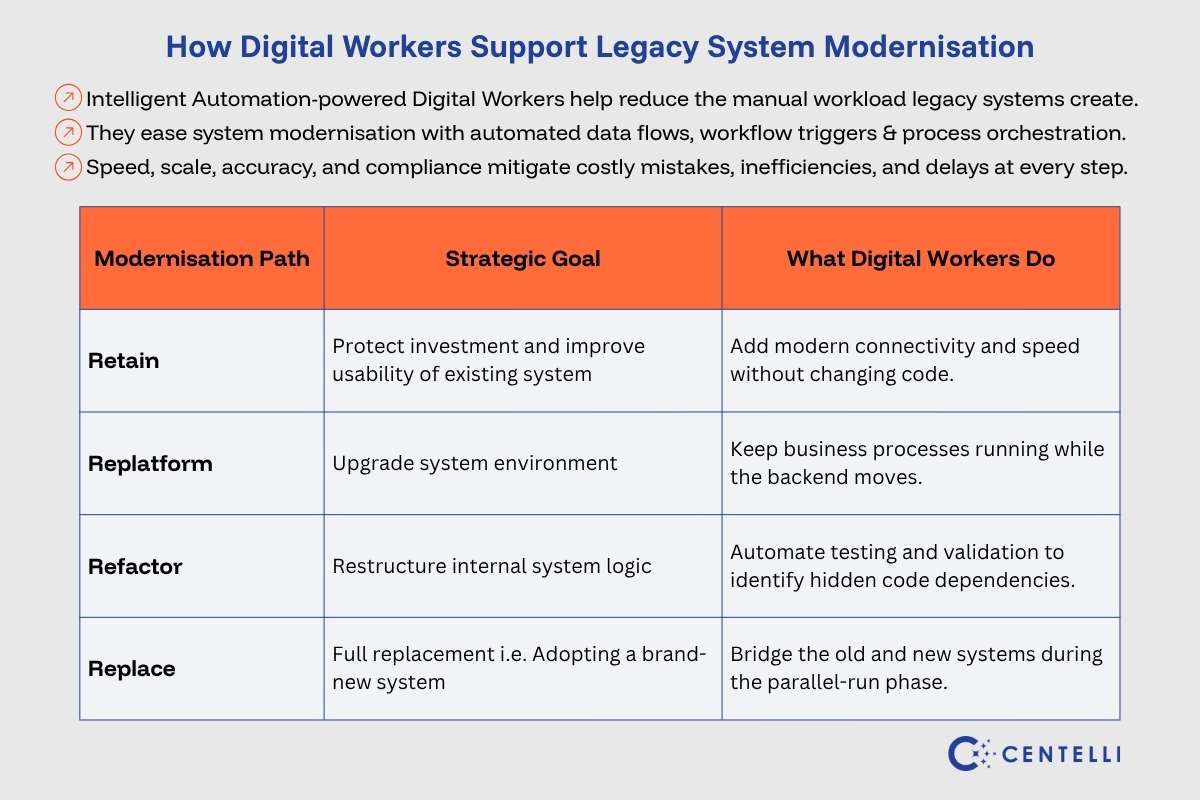
Interestingly, legacy systems are often aged, not broken, and are incredibly stable. This is a key reason why they are still in use. Is your organisation also not considering a large-scale upgrade or replacement yet? Modernising legacy systems that you want to retain via Digital Worker integration is a pragmatic route. This allows you to continue to leverage the equity of what is already familiar, functional, and stable—now with elevated performance.
Curious to know how Centelli’s AI-powered Digital Worker automation can help modernising legacy systems at your organisation? Schedule a free consultation today.
Smarter Legacy Migration with Digital Workers
- While modernising legacy systems, the migration phase is quite painful. Transition is tricky when you move your system to a new platform, reconstruct its core architecture, or fully replace it with a new model.
- Data loss, downtime, and budget overruns are constant risks.
- Digital Workers help mitigate these challenges with proactive data management, compliant workflows and timely task completion.
- For many enterprise leaders, a failed migration is a bigger concern than the legacy system itself.
Watch the video: Migrating to S/4HANA Fireside Chat. Mark Darbyshire, Strategic Partnerships @ UiPath, and Aneesh Gupta, Managing Director at Centelli, discuss SAP HANA migration challenges as well as Centelli’s UiPath-powered HANAReady solution.
5 Benefits of Using Digital Workers in System Migration
Legacy modernisation often stalls due to technical complexity and resource limits. These five benefits underscore how Digital Workers are useful during a full system migration.
- Data Management: Digital Workers can reliably manage the record-to-report data cycle from pre-migration to post-migration. They validate data against pre-defined rules, orchestrate real-time data sync in parallel runs, and automate reconciliations and reporting workflows.
- Security and Governance: You can programme a Digital Worker to follow GDPR (EU) rules, HIPPA (US healthcare), or any other country’s local regulations as needed. While handling data, they also create an end-to-end digital audit trail of every action. This compensates for legacy systems that lack modern logging or transparent audit trails.
Also Read: Data Management Automation with Digital Workers
- Cost Effectiveness: Digital Workes as Digital Employees deliver measurable FTE savings. Automation reduces manual “swivel-chair” processing during system migrations. High accuracy at scale saves costly reworks. This also frees teams for other strategic tasks, improving workload distribution and resource allocation.
- Easy Implementation: ‘Technical debt’ can be a dampener in legacy modernisation. However, Digital Workers interact with the system UI (interface level) and are configured to handle interface shifts. They bypass the need for deep-code integration and save the hassle of custom API development or complex middleware installation on the legacy side.
- Business Continuity: Digital Workers also play a significant role in business continuity when migration is underway. They keep processes running steadily while systems are being upgraded, rebuilt, or replaced. This shields customers, employees, and partners from unplanned or extended downtimes.
Email us if you want to learn more about Intelligent Automation i.e. Digital Workers’ role in modernising legacy systems.