
- Agentic Automation
- Written By Namita Bhagat
Agentic Automation Compliance Starts with a Solid Roadmap
21-Nov-2025 . 5 min read
Your legacy automations no longer fully meet scaling business needs? So, you are considering going ‘agentic’! But have you thought through your Agentic Automation Compliance Roadmap yet? Why build your compliance roadmap before anything else?
Because agentic systems are almost autonomous. They think independently, reason, and take action. Before enabling this level of autonomy, you must set up clear boundaries. These boundaries ensure decisions adhere to ethical standards, regulatory expectations, and governance frameworks. Planning upfront helps you navigate complexity, set guardrails, and prepare your organisation to scale agentic workflows confidently.
In this blog, we’ll explore how you can balance innovation, regulation, and governance for agentic automation initiatives. From idea to implementation, you need a clear approach to keep innovation aligned with compliance. We’ll break it down into three practical phases, showing how to move fast without risking compliance or control.
What Agentic Automation Compliance Really Means
Compliance in agentic automation ensures your autonomous business processes are designed, built, deployed, and operated correctly. Everything meets best practices, ethical standards, and regulatory requirements!
It also defines how your organisation governs data, decisions, and accountability across the automation lifecycle. This keeps agentic systems transparent, reliable, and auditable. Without these foundations, even well-intended agentic systems can create avoidable risks. For example:
- A retail customer-support agent may pull unverified data into responses, accidentally breaching GDPR / EU data privacy norms, for instance.
- A banking agent interpreting incomplete rules could approve a high-risk transaction, triggering audit flags.
- A logistics routing agent might optimise delivery speed but overlook customs documentation rules, causing delays or penalties.
A strong compliance roadmap turns these principles into a structured plan. This provides clarity, accountability, and direction for safe, scalable implementation. Plus, it ensures your organisation prevents such failures before they occur. It also enables systems to innovate responsibly, operate reliably, and withstand regulatory scrutiny.
Integrating Compliance in Agentic Implementations
Integrating compliance into your agentic automation shouldn’t be an afterthought. Rather, it’s essential at every phase. From foundational frameworks to innovation and governance, a structured approach is key. This facilitates safe, reliable operations — all in line with regulations and best practices.
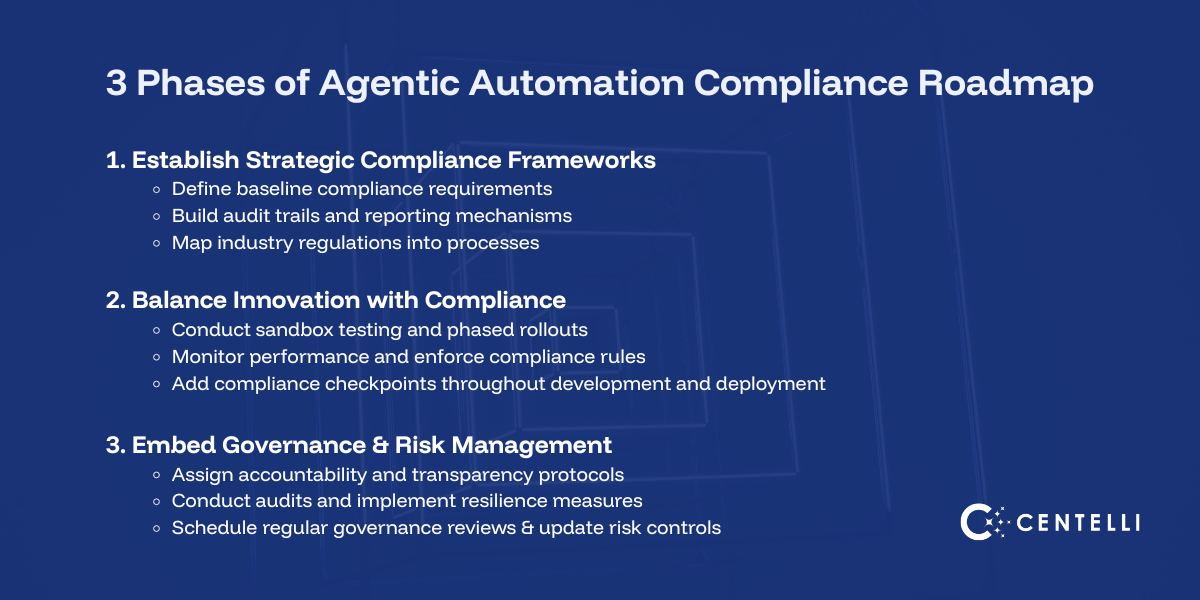
Here’re the three key phases to achieving a solid compliance strategy:
Phase 1: Establishing Strategic Compliance Frameworks
Laying the foundation for agentic automation compliance starts with a clear plan. Treat compliance as your baseline! Automation becomes a liability instead of an asset without it. Embed audit trails, reporting tools, and data-handling standards early. Think of it as building guardrails before your agentic systems hit the road.
Many industries show the value. Points in case:
- Financial services in UK follow FCA guidelines
- Healthcare companies in USA adhere to HIPAA
- Manufacturing sector relies on global ISO standards
- Hospitality ensures compliance with GDPR (EU/EEA) or CCPA (USA) and global PCI standards
- Logistics/supply chain enforces safety, customs & operational standards specific to each region
Aligning early prevents costly mistakes and builds stakeholder confidence.
How to do this:
- Define compliance as the baseline: Automation without it is a liability.
- Embed compliance early: You must build audit trails and data standards into workflows from day one.
- Learn from industry standards: Early alignment reduces risk and builds confidence.
How it may look in action:
- A financial institution implementing agentic credit scoring needs frameworks for auditability, data privacy, and bias monitoring.
- A hotel booking system must protect guest data, while a logistics firm’s routing agent must comply with customs and safety regulations.
Setting this up early reduces risk and builds a strong foundation.
Phase 2: Balancing Innovation with Compliance
Once your compliance framework is in place, the next step is innovating safely. This is often the bigger challenge. Some businesses worry that regulations will slow them down! But with agentic automation, the opposite is true.
In fact, compliance is your steering wheel, guiding innovation without hitting roadblocks. Which means you should:
- Test new capabilities in sandboxes
- Roll them out in phases
- Monitor continuously to ensure rules are followed.
Result: your agentic systems can innovate and refine while respecting standards.
How to do this:
- Rethink the compliance–innovation equation: Regulations should guide innovation, not hinder it.
- Adopt best practices: Do it for every phase be it development, testing, launch, and post implementation monitoring.
- Use compliance as your North Star: Helps keep autonomous systems on track.
How it may look in action:
- An automotive company deploying an agentic assembly scheduler ensures safety and quality standards are met automatically.
- A retail chain using an autonomous pricing agent adjusts promotions while staying compliant with consumer-protection rules.
- A BPO using agentic service agents maintains data privacy and service-level standards.
Phase 3: Embedding Governance and Risk Management
Strong governance keeps your agentic systems on track over time. Set clear accountability: who owns decisions, how results are evaluated, and how progress is reported. Also, prioritise risk management. Auditability, resilience, and continuous improvement will protect your business from surprises.
Think of it this way. A healthcare provider’s scheduling agent constantly checks regulatory requirements and updates workflows as rules change. Or a logistics routing agent monitors safety and customs compliance. Or a hospitality concierge agent ensures privacy and billing accuracy.
Hence, governance turns compliance from a checklist into an operational advantage. It becomes a driver of operational strength, not just an obligation.
How to do this:
- Treat governance as the backbone: You must establish accountability and transparency protocols early on.
- Prioritise risk management. This requires proactive monitoring and resilience planning.
- Turn compliance into a value driver. Remember, responsible innovation builds trust.
How it may look in action:
- A healthcare provider’s scheduling agent continuously aligns with clinical, privacy, and regulatory updates.
- A manufacturing firm’s quality-inspection agent flags defects while meeting safety-compliance requirements.
- A telecommunications provider’s network-optimisation agent ensures configuration changes adhere to regulatory and service-continuity standards.
Explore Agentic Automation in detail -> Agentic Process Automation: The Next Leap in Enterprise Automation
Navigating Agentic Automation Compliance with Ease
A strong ‘Agentic Automation Compliance Roadmap’ is more than a checklist. It serves as your guide to safe, effective, and scalable automations. It ensures your initiatives align with business goals, regulatory standards, and ethical expectations. Done right, it builds trust with customers, regulators, and stakeholders. It unlocks faster, safer growth ultimately!
Ready for agentic automation? Let’s help you build a compliance‑first roadmap and tailored solutions that drive real strategic value. Contact us to get started.