
- Digital Workers
- Written By Namita Bhagat
Customer Service Automation ROI: Where Digital Workers Pay Back Faster
20-Jan-2026 . 4 min read
Customer service automation ROI remains the top concern for service leaders.
Significantly, automating with Digital Workers suits this critical function perfectly. Many tasks are repetitive, time-sensitive, and resource-intensive. Here, these specialized software bots handle a broad range of work, much like a human team member, but at scale!
So, where do Digital Workers unlock faster ROI in customer service?
In our experience, success depends on how deliberately you choose where automation belongs within the operation. Let’s unpack this for you.
Not All Customer Service Work Is Created Equal
Customer service operations typically span a mix of work:
- Some tasks are routine and predictable.
- Some are judgment-heavy and situational.
- Many sit somewhere in between.
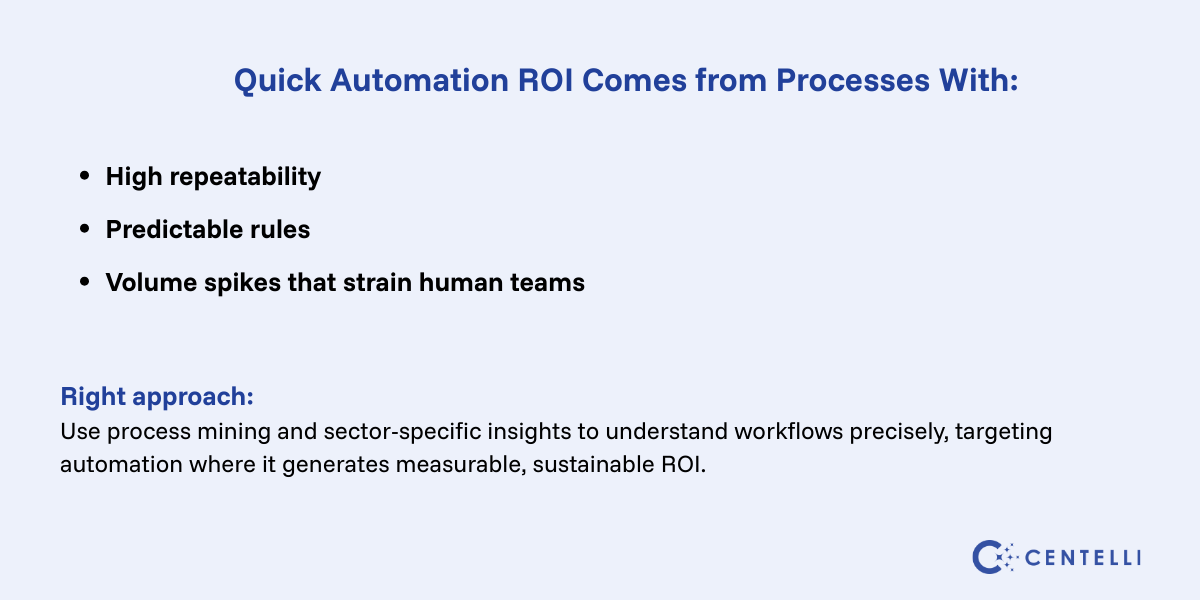
Specifically, the fastest ROI appears where three conditions overlap: repeatability, clear rules, and demand fluctuation.
However, returns vary significantly between deterministic and probabilistic tasks.
For instance, order status updates, service request tracking, or bill splitting are structured and rule based. They appear simple. However, routine execution and sudden volume spikes can often create operational drag. In these cases, classic Digital Workers deliver value quickly. They absorb pressure during peak demand, improve throughput, and increase accuracy. Moreover, they provide scalable capacity without disrupting customer experience.
By contrast, probabilistic or judgment-dependent work can extend the ROI timeline.
This happens for two practical reasons:
1. These tasks require AI, machine learning, and deeper integration. This raises upfront costs.
2. Sensitive decisions still require humans in the loop, which limits immediate FTE savings.
Customer service AI-only pilots often fail (or struggle to scale) because they ignore the need for strong foundational data flows. Most successful leaders start with deterministic automation, ensuring data moves correctly and consistently before layering in more complex AI capabilities.
Digital Workers designed for unstructured data are more advanced, notably. They are built not to just follow scripts! They can also interpret scenarios, intent, and context to execute tasks like document processing or email triage.
Customer Service Areas Where Digital Workers Pay Back Faster
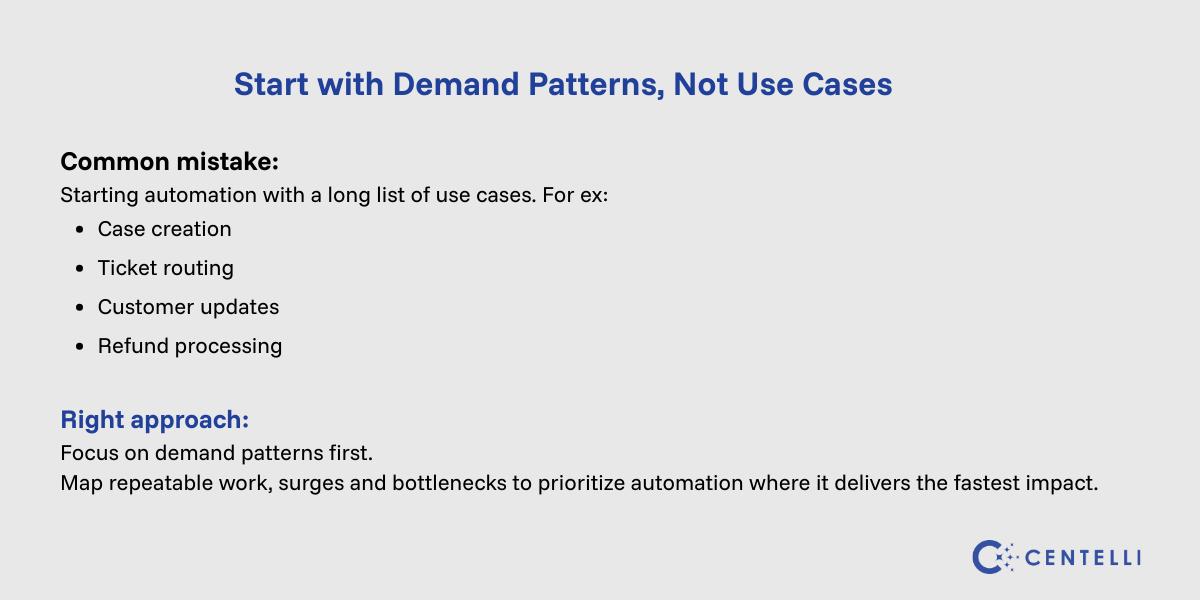
A common instinct suggests starting automation at the most visible points in the customer journey. After all, everyone wants to wow customers!
Sadly, this approach rarely delivers the fastest returns. So, where should automation start instead?
Consider these three areas:
a. Behind-the-Scenes Processes
High-impact starting points usually sit behind the scenes. And they specifically focus on pre-work and post-work around customer interactions. For example:
- Extract data from receipts, so agents don’t manually enter line items
- Running KYC checks before a loan officer opens a case
- Running diagnostics before a customer reaches a technical agent
Simply put, you should remove any task that does not benefit from human creativity. This change reduces average handling time (AHT) almost immediately. Furthermore, it enhances consistency without altering the customer’s experience (CX) of the brand.
Ultimately, a key goal is to eliminate “stale time”. By the time a case reaches a human, a Digital Worker has already gathered and organized the information.
b. Data and Cross-System Navigation
Leaders often pursue automation to improve First-Contact Resolution (FCR). While ambition is good, sequencing can be counterproductive.
In many contact centres, agents act as “human middleware.” They manually move data between legacy systems and modern CRMs. Consequently, they spend much of their energy navigating silos.
Customer service faces some of the highest burnout and turnover rates. Automation, therefore, isn’t just about saving money; it’s about stopping your best people from quitting because they’re tired of acting as human middleware. In this way, automation also delivers a “shadow ROI” through improved employee retention.
Because FCR depends on judgment and immediate access to data, automation struggles when the foundation is fragmented. However, automated synchronization before the conversation improves FCR. As a result, ROI emerges when Digital Workers provide agents with a single, accurate customer view.
c. Low-Profile, Stable Processes
Digital Workers deliver ROI fastest where core logic remains stable. Additionally, this stability creates a reliable audit trail.
Common use cases include:
- Address updates and shipping redirects in logistics.
- Generating standardized account statements in banking.
- Entitlement checks for field service operations.
Conversely, processes like complaint handling are poor starting points. They change often and carry greater sensitivity. But more stable low-profile tasks would create a “stability dividend”: automations that run for years with minimal maintenance.
Want to see how Digital Workers can unlock ROI in your customer service workflows? Book a free assessment with our experts here.
Does Automation ROI Differ Across Customer Service Models?
Customer service models vary across retail, services, and contact centres. The logic that underpins automation advantage is consistent, nevertheless.
Returns appear when automation improves foundational metrics:
- You reduce reliance on human intervention for routine work.
- You achieve faster processing cycles with improved accuracy.
- You gain the ability to absorb growing demand without service degradation.
When automations move these levers in measurable ways, ROI follows.
Execution Is Where You Win (or Lose) Customer Service Automation ROI
Customer service automation succeeds when your assumptions about the work are right. You can achieve the strongest results when:
- You frame automation as an operational choice, not just technology.
- You measure impact on capacity and resilience, not just cost.